History of the Ann Arbor high school bands
The following article by Daryl Hurst appeared in the June 2006 issue of the Ann Arbor Observer.
The old Ann Arbor High School is coming down. But while its bricks and mortar meet the wrecking ball this summer, the school's spirit lives on in the band program that was born at the corner of State and Huron. Among the stories that will last beyond the crumbled walls, perhaps the history of the band best captures the pioneer spirit of the school.
The old Ann Arbor High School is coming down. But while its bricks and mortar meet the wrecking ball this summer, the school's spirit lives on in the band program that was born at the corner of State and Huron. Among the stories that will last beyond the crumbled walls, perhaps the history of the band best captures the pioneer spirit of the school.
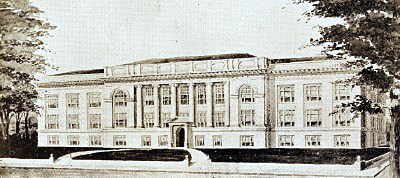
According Verne Collins's 1965 doctoral dissertation Music in Ann Arbor High School, "the individual who was most influential in establishing and supporting music in the high school was Henry Simmons Frieze." How appropriate, then, that when the university acquired the former Ann Arbor High in 1955, it renamed it in honor Frieze, a nineteenth-century professor and acting president of the university. Largely because of Frieze's vision and efforts, one of the nation's premier high school music programs was born within those walls.
Hired in 1854 as chair of the Latin department, Frieze also had a passion for music. A former church organist, he was instrumental in the formation of both the Choral Union and the School of Music, which at first was an independent entity connected with both the university and Ann Arbor High.
Music had been part of the curriculum when Ann Arbor opened one of the nation's first high schools in 1856, but over the school's first fifty years, the battles over academics versus arts ensured that music courses never stayed in place very long. Music instruction usually took the form of singing or piano, leaving instrumental ensembles to be formed by students as extracurriculars. The first was a Banjo Club in 1892, followed by a mandolin club in 1895. What could be considered the first orchestra at Ann Arbor High also formed in 1895, but like its successors over the next several years, it was more of a dance band and usually had more winds than strings.
Hired in 1854 as chair of the Latin department, Frieze also had a passion for music. A former church organist, he was instrumental in the formation of both the Choral Union and the School of Music, which at first was an independent entity connected with both the university and Ann Arbor High.
Music had been part of the curriculum when Ann Arbor opened one of the nation's first high schools in 1856, but over the school's first fifty years, the battles over academics versus arts ensured that music courses never stayed in place very long. Music instruction usually took the form of singing or piano, leaving instrumental ensembles to be formed by students as extracurriculars. The first was a Banjo Club in 1892, followed by a mandolin club in 1895. What could be considered the first orchestra at Ann Arbor High also formed in 1895, but like its successors over the next several years, it was more of a dance band and usually had more winds than strings.
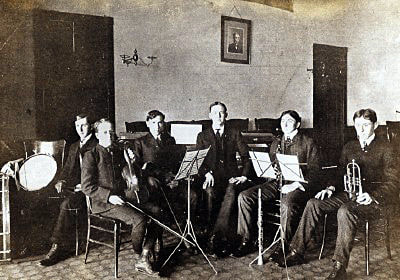
1903 Orchestra
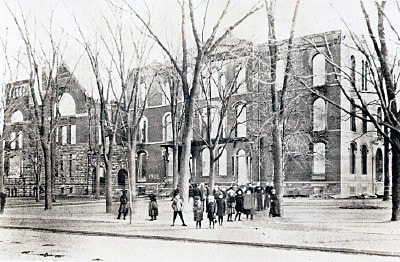
Remains of original Ann Arbor High School after 1904 fire
When a spectacular New Year's Eve fire consumed the school building in 1904, classes were forced to meet in community buildings, and the formation of music ensembles stalled. But when a new and better Ann Arbor High School opened in 1907, school life resumed quickly, and student music groups re-formed.
Meanwhile, music was flourishing at the U-M, much to the benefit of nearby Ann Arbor High. In 1914, Earl V. Moore of the School of Music set Margaret Cooley's "Purple and White" to music, giving Ann Arbor High its alma mater. (Moore later composed "Push On," the school fight song.) And during the 1913–1914 school year, the first instrumental ensemble of strictly wind and percussion instruments — what we identify as a band — was formed at Ann Arbor High. No doubt it was modeled on popular bands of the day like Sousa's and the local Otto's Band.
The 1914 Omega credits principal W. Merton Aikin with leading the call for players. Eighteen boys were selected, and the new band made its first appearance at the Muskegon football game that fall. "The Band, one of the many things which go to make our school stand head and shoulders above all others, is one of the many new organizations which arouse out of Mr. Aikin's ingenious head, during the past year," the Omega boasted. A picture of the musicians on the front steps of Ann Arbor High commemorates that pioneering group of bandsmen.
Meanwhile, music was flourishing at the U-M, much to the benefit of nearby Ann Arbor High. In 1914, Earl V. Moore of the School of Music set Margaret Cooley's "Purple and White" to music, giving Ann Arbor High its alma mater. (Moore later composed "Push On," the school fight song.) And during the 1913–1914 school year, the first instrumental ensemble of strictly wind and percussion instruments — what we identify as a band — was formed at Ann Arbor High. No doubt it was modeled on popular bands of the day like Sousa's and the local Otto's Band.
The 1914 Omega credits principal W. Merton Aikin with leading the call for players. Eighteen boys were selected, and the new band made its first appearance at the Muskegon football game that fall. "The Band, one of the many things which go to make our school stand head and shoulders above all others, is one of the many new organizations which arouse out of Mr. Aikin's ingenious head, during the past year," the Omega boasted. A picture of the musicians on the front steps of Ann Arbor High commemorates that pioneering group of bandsmen.
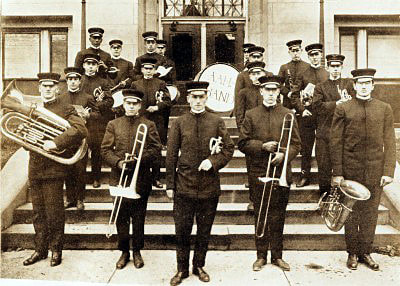
The first Ann Arbor High School Band formed in the 1913–1914 school year
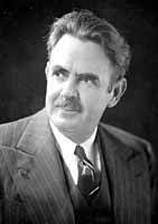
Joe Maddy in 1928; photo courtesy of Interlochen Center for the Arts
The band formed again in the 1914–1915 school year. It marched at football games and the city's Thanksgiving Day Parade and presented a joint concert in the spring with the orchestra and glee club. Perhaps derailed by the US entry into World War I, however, the band then disappeared for another decade.
It would take a visionary man to re-define the band and make it a permanent fixture at Ann Arbor High School. That man was Joe Maddy, who went on to create the world-famous National Music Camp at Interlochen, and who today is considered by many to be the father of instrumental music in the public schools of America.
Maddy was called to Ann Arbor in the fall of 1924 by Earl Moore, who had just become head of the School of Music. With thrifty ingenuity, Moore arranged for Maddy to work half-time as head of music education at the U-M and half-time as music supervisor in the Ann Arbor Public Schools. Maddy's enthusiasm and vision for advancing music education would find fertile ground in Ann Arbor. In his three years at Ann Arbor High, Maddy re-formed the band and orchestra. An innovative instructor, he established the early traditions of musical excellence at the school. Maddy was also a good promoter, persuading the administration to provide funds for instruments and working with the local Rotary Club to purchase new uniforms. Because of confusion with the school administration over course definitions, academic credits, and scheduling, however, the band and orchestra comprised the same students, who would simply play different instruments on different days.
The influence of Joe Maddy and Interlochen on the world of high school music is legendary, but not everybody appreciated his groundbreaking work. In his book Interlochen, A Home for the Arts, Dean Boal relates how Ann Arbor school superintendent Otto Haisley, hired the same year as Maddy, grew increasingly frustrated with his employee's new venture in northern Michigan. Haisley called Maddy "a crazy damn fool" for undertaking "a fool project like the camp" and fired him from the public schools. (Maddy's own version, as told to Verne Collins, was that he resigned so that he could devote more time to the camp.)
After Maddy's departure the band and orchestra became more distinct, with different conductors, different rehearsal times, and different members. But in a reprise of Maddy's double duty, Nicholas Falcone, the newly hired Director of Bands at the U-M, also directed the band at Ann Arbor High for the 1927–1928 school year.
It would take a visionary man to re-define the band and make it a permanent fixture at Ann Arbor High School. That man was Joe Maddy, who went on to create the world-famous National Music Camp at Interlochen, and who today is considered by many to be the father of instrumental music in the public schools of America.
Maddy was called to Ann Arbor in the fall of 1924 by Earl Moore, who had just become head of the School of Music. With thrifty ingenuity, Moore arranged for Maddy to work half-time as head of music education at the U-M and half-time as music supervisor in the Ann Arbor Public Schools. Maddy's enthusiasm and vision for advancing music education would find fertile ground in Ann Arbor. In his three years at Ann Arbor High, Maddy re-formed the band and orchestra. An innovative instructor, he established the early traditions of musical excellence at the school. Maddy was also a good promoter, persuading the administration to provide funds for instruments and working with the local Rotary Club to purchase new uniforms. Because of confusion with the school administration over course definitions, academic credits, and scheduling, however, the band and orchestra comprised the same students, who would simply play different instruments on different days.
The influence of Joe Maddy and Interlochen on the world of high school music is legendary, but not everybody appreciated his groundbreaking work. In his book Interlochen, A Home for the Arts, Dean Boal relates how Ann Arbor school superintendent Otto Haisley, hired the same year as Maddy, grew increasingly frustrated with his employee's new venture in northern Michigan. Haisley called Maddy "a crazy damn fool" for undertaking "a fool project like the camp" and fired him from the public schools. (Maddy's own version, as told to Verne Collins, was that he resigned so that he could devote more time to the camp.)
After Maddy's departure the band and orchestra became more distinct, with different conductors, different rehearsal times, and different members. But in a reprise of Maddy's double duty, Nicholas Falcone, the newly hired Director of Bands at the U-M, also directed the band at Ann Arbor High for the 1927–1928 school year.
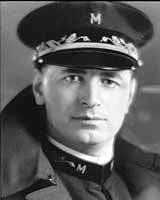
Nicholas Falcone, shown in photo
This was the same year that the Michigan Stadium opened, and Falcone was busy introducing military-style drill into the Michigan Marching Band's on-field performances. He soon found his work at the U-M consumed all his time, so he did not continue in the high school position. Falcone remained at the U-M for several more years, but was forced to resign by a tragic hearing loss; his successor was the legendary bandleader William Revelli.
Falcone's successor at Ann Arbor High, William Champion, was the first of many long-serving directors, all of whom built the band program's high standards, traditions, and strong esprit de corps. Champion expanded the band program, oversaw the admittance of the first female musicians, and gave the marching band a snappy military style. He also worked to make the band a strong concert ensemble, adding instruments not used in marching like the oboe, the bassoon, and the alto and bass clarinet. Champion also started band programs in the elementary and junior high schools.
Under Champion the students presented the first "Band Frolic," which included several novelty acts along with the standard concert music. After a few years, this gave way to a more formal performance, which continues to this day in the form of the high schools' Winter Band Concert. Champion had also taken over the direction of the orchestra in 1930, but whether his style or other circumstances were to blame,
orchestra membership dwindled until the band was twice its size. He must have been a capable orchestral conductor, however, as he also directed the Ann Arbor Symphony Orchestra from 1933 to 1941.
Falcone's successor at Ann Arbor High, William Champion, was the first of many long-serving directors, all of whom built the band program's high standards, traditions, and strong esprit de corps. Champion expanded the band program, oversaw the admittance of the first female musicians, and gave the marching band a snappy military style. He also worked to make the band a strong concert ensemble, adding instruments not used in marching like the oboe, the bassoon, and the alto and bass clarinet. Champion also started band programs in the elementary and junior high schools.
Under Champion the students presented the first "Band Frolic," which included several novelty acts along with the standard concert music. After a few years, this gave way to a more formal performance, which continues to this day in the form of the high schools' Winter Band Concert. Champion had also taken over the direction of the orchestra in 1930, but whether his style or other circumstances were to blame,
orchestra membership dwindled until the band was twice its size. He must have been a capable orchestral conductor, however, as he also directed the Ann Arbor Symphony Orchestra from 1933 to 1941.
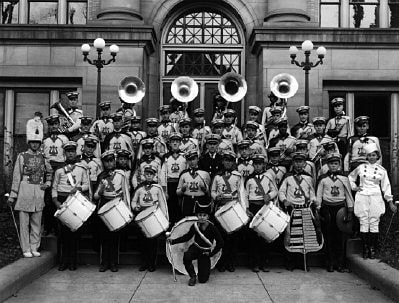
1935 Ann Arbor High School Band under William Champion
The tradition of marching from the high school to the football games was established during Champion's tenure. Local radio personality Ted Heusel, who played trombone in the band in the 1930s, recalls that the musicians would march down Huron and Main streets to Wines Field (now Elbel Field on Hill St. where the Michigan Marching Band practices). Heusel remembers how deliciously distracting the smell wafting from Quality Bakery was as the band passed by its building on Main near William (now Palio restaurant). Champion also instituted the "AA" formation on the field, which continued until 1969, when the division of the school into Pioneer and Huron high schools forced a change to separate "P" and "H" formations.
Champion, an officer in the naval reserves, was called to active duty in 1941. Once again, the world at war seems to have an impact on the numbers of students involved in band: from a high of fifty-eight under Champion, membership dropped to thirty-seven under new director E. Rollin Silfies. Silfies introduced new formations to the marching band, but after his first year the orchestra was handed over to newly hired Elizabeth Green, who would rebuild the program into the first-rate institution that we still enjoy today. Between the war and bad weather that limited the band's appearances at football games, it seems that Silfies second year was even less successful; he left Ann Arbor at the end of the 1942–43 school year.
Charles M. Yates, the director for the next three years, seemed to regain some ground in student numbers and in the concert performance level of the band, which even participated in the U-M May Festival at Hill Auditorium. For reasons that are unclear, however, Yates left at the end of 1945–1946 school year.
After Yates left, Superintendent Haisley convinced former colleague Clarence Roth to come to Ann Arbor and take over the instrumental music programs.
Haisley's first charge to Roth was to get new uniforms for the band; the old ones from Champion's time were faded and worn. Roth put together the first "Bands in Review" concert in 1947 as a fundraiser. The uniform salesman convinced Roth that purple dye just didn't hold up, so the new uniforms were maroon with gold piping. While later generations of band members would ridicule this choice of colors, Roth and his band wore their spiffy new uniforms with pride.
Roth brought back Bands in Review in 1950 and made it a permanent institution in the Ann Arbor Public Schools, featuring all the district's middle school and high school bands. The same year, Roth began taking the high school band to state competitions, where it consistently received first-division ratings. In the postwar boom, Huron and Main streets became business routes for the new Interstate highway system, so the band now marched to the Friday night football games down State to Hill and west to Wines Field, with the school victory bell carried up front.
Champion, an officer in the naval reserves, was called to active duty in 1941. Once again, the world at war seems to have an impact on the numbers of students involved in band: from a high of fifty-eight under Champion, membership dropped to thirty-seven under new director E. Rollin Silfies. Silfies introduced new formations to the marching band, but after his first year the orchestra was handed over to newly hired Elizabeth Green, who would rebuild the program into the first-rate institution that we still enjoy today. Between the war and bad weather that limited the band's appearances at football games, it seems that Silfies second year was even less successful; he left Ann Arbor at the end of the 1942–43 school year.
Charles M. Yates, the director for the next three years, seemed to regain some ground in student numbers and in the concert performance level of the band, which even participated in the U-M May Festival at Hill Auditorium. For reasons that are unclear, however, Yates left at the end of 1945–1946 school year.
After Yates left, Superintendent Haisley convinced former colleague Clarence Roth to come to Ann Arbor and take over the instrumental music programs.
Haisley's first charge to Roth was to get new uniforms for the band; the old ones from Champion's time were faded and worn. Roth put together the first "Bands in Review" concert in 1947 as a fundraiser. The uniform salesman convinced Roth that purple dye just didn't hold up, so the new uniforms were maroon with gold piping. While later generations of band members would ridicule this choice of colors, Roth and his band wore their spiffy new uniforms with pride.
Roth brought back Bands in Review in 1950 and made it a permanent institution in the Ann Arbor Public Schools, featuring all the district's middle school and high school bands. The same year, Roth began taking the high school band to state competitions, where it consistently received first-division ratings. In the postwar boom, Huron and Main streets became business routes for the new Interstate highway system, so the band now marched to the Friday night football games down State to Hill and west to Wines Field, with the school victory bell carried up front.
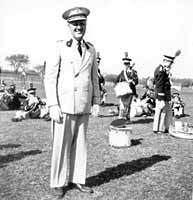
Roth at U-M Band Day in 1952
Roth exposed the band to new music, new bandleaders, and new experiences. Roth had met the U-M's Bill Revelli years earlier, and in 1946, Revelli's office and the rehearsal space for the Michigan Marching Band moved into Harris Hall, kitty-corner across from the high school. Revelli had frequent contact with the high school band, and invited it to participate in the first Band Day at Michigan Stadium in 1951.
Under Roth the band also began to tour, performing at the International Lions Club Conventions in Chicago, New York City, and Miami in 1953–1956. In 1956 the Ann Arbor High School Band hosted nationally renowned conductor Paul Lavalle in a special concert at Hill Auditorium.
Under Roth the band also began to tour, performing at the International Lions Club Conventions in Chicago, New York City, and Miami in 1953–1956. In 1956 the Ann Arbor High School Band hosted nationally renowned conductor Paul Lavalle in a special concert at Hill Auditorium.
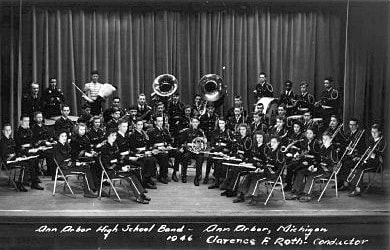
The 1946 Ann Arbor High School Band on the stage of Pattengill Auditorium in old Ann Arbor High in 1946.
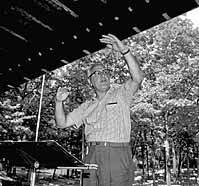
Roth at Interlochen in 1960
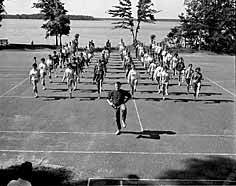
LEFT: Tennis court marching drills
|
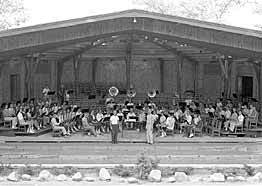
RIGHT: Concert rehearsals in the Bowl - Photos courtesy Interlochen Center for the Arts
|
This was likely the first high school band camp of its size and scope in the nation. This August will mark the fifty-ninth annual band camp for Ann Arbor high school students, who will live in the same cabins, hold social events in the same lodge, and rehearse in the same hall as generations before them.
Within a few years after the end of World War II, Ann Arbor school trustees began to plan for a new, larger high school to accommodate the baby boom. In a land swap between the U-M and the public schools, the high school gave up its home at State and Huron and on the Wines athletic field for a new campus on the large parcel of land diagonally across from the Michigan Stadium.
Within a few years after the end of World War II, Ann Arbor school trustees began to plan for a new, larger high school to accommodate the baby boom. In a land swap between the U-M and the public schools, the high school gave up its home at State and Huron and on the Wines athletic field for a new campus on the large parcel of land diagonally across from the Michigan Stadium.
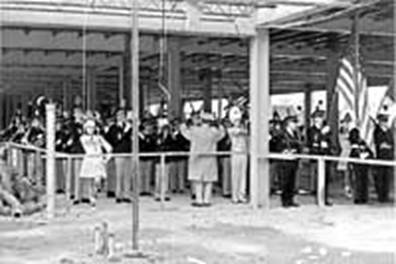
Roth & the band at the cornerstone dedication for the new school
Roth helped design a tiered band room, practice rooms, and a spacious auditorium for the new high school. The band program moved into its new home at Main and Stadium in April 1956 with the rest of the student body, faculty and staff. It wasn't long before the band program established the annual Picnic Pops Concert on the front lawn of the new building.
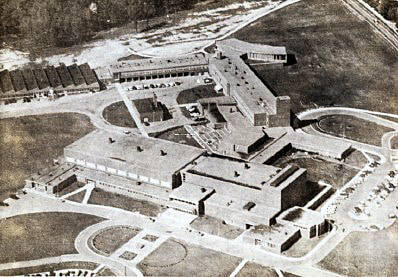
Aerial view of the new high school opened in April 1956
At the new school, the bands saw unprecedented growth and success under another series of excellent directors. When Ann Arbor High was split into Huron and Pioneer, the band program also divided into two—and both have thrived, winning national recognition by music educators and adjudicators. The Grammy Foundation has designated both Huron and Pioneer as Signature Schools several times in recent years, placing their overall music programs (bands, orchestras and choruses) among the top few dozen
in the country.
It was a fitting tribute to the band program at old Ann Arbor High, which established the foundations for the long-term success and excellence of music in the Ann Arbor Public Schools. Henry Frieze himself would have been proud to know that in a building that later carried his name, nationally renowned band programs would be born.
in the country.
It was a fitting tribute to the band program at old Ann Arbor High, which established the foundations for the long-term success and excellence of music in the Ann Arbor Public Schools. Henry Frieze himself would have been proud to know that in a building that later carried his name, nationally renowned band programs would be born.
This article is based on research for The Centennial Project. Initiated by Daryl Hurst to commemorate the history of Ann Arbor's high school band program, the project is expected to culminate in a centennial celebration on the band's 100th anniversary in 2014.
The Centennial Project is also focused on the present and future of the Ann Arbor high school band programs. Some young members of the Class of 2014 were gathered as potential band members for a commemorative photograph on the front steps of the Frieze Building last November, posing in a style that mimics the historic photograph of that 1914 band. The project plans to follow the progress of these current fourth grade students as they progress in the Ann Arbor Public School's instrumental music program.
The Centennial Project is also focused on the present and future of the Ann Arbor high school band programs. Some young members of the Class of 2014 were gathered as potential band members for a commemorative photograph on the front steps of the Frieze Building last November, posing in a style that mimics the historic photograph of that 1914 band. The project plans to follow the progress of these current fourth grade students as they progress in the Ann Arbor Public School's instrumental music program.
